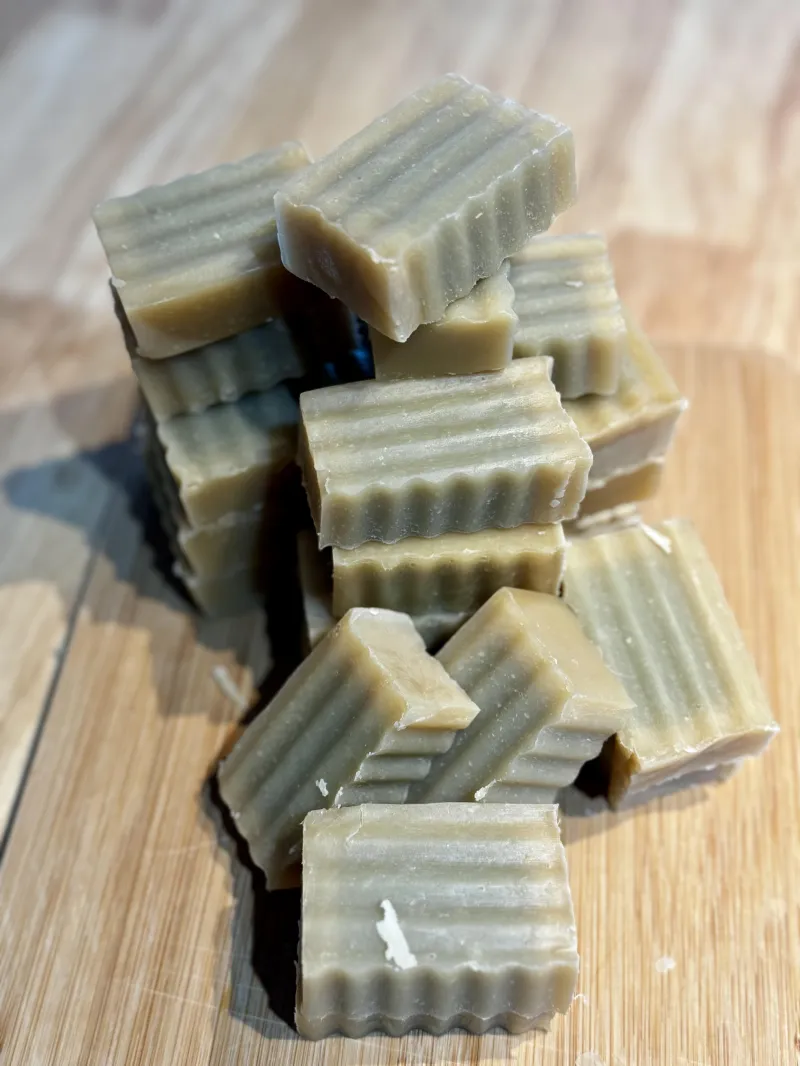
What makes homemade shampoo bars better than store brands? I've focused on the required ingredients, and used no synthetic additives.
No sulfates, ever. Sulfates can dry out your hair and irritate your scalp, and they show up in more ways than you'd think. Even "sulfate-free" products often contain lookalikes (check your labels for anything that starts with sulf-).
No filler ingredients or shortcuts. Commercial shampoo bars often use synthetic additives to speed up production or extend shelf life. I don't. The only "extra" I use is sodium lactate, a natural salt that helps the bar last longer in your shower and adds a touch of hydration.
Superfatted for Moisture
Extra nourishing oils remain in the bar after saponification to condition your hair and scalp, especially great for dryness or sensitivity.
Naturally Retained Glycerin
Unlike commercial soaps that strip glycerin, the cold process method retains this ultra-hydrating byproduct for soft, moisture-balanced hair.
Targeted Scalp Additives
Panthenol (Provitamin B5): Strengthens and softens hair.
Neem Oil: Antibacterial, antifungal, ideal for scalp care.
Sodium Lactate: Helps the bar last longer and gently hydrates.
No Fillers or Silicones
Every oil, butter, and additive was chosen with purpose — no mystery fillers, no coating agents, just real ingredients you recognize.
Small Batch, Hand Poured
Made in small batches, poured by hand, and cured for 4–6 weeks for a longer-lasting, harder bar that performs beautifully.
Aromatherapy Blends with Benefits
Each scent profile isn't just for smell — it's designed to support mood, mental clarity, or emotional balance while offering topical benefits for your scalp and hair.
The shower thought that started it all
Why do I obsessively read food labels, but never question what I'm rubbing into my scalp and skin every day?
One look at the back of my so-called "natural" shampoo — sulfate-free, paraben-free, all the right words — left me completely bamboozled. That label was a mess of mystery ingredients.
So I did what I always do: went down the rabbit hole. I started researching what each ingredient actually does, what's needed, and what's just filler.
And I realized, I wanted something simple. Something that works. Something I feel good about scrubbing into my scalp.
That's my promise to you: full transparency, no BS marketing tactics. Just ingredients that support your hair, your scalp, and your health, with nothing to hide.
Why only shampoo bars?
It all started with my too-fine hair and my scalp. I've always struggled to find a shampoo that doesn't weigh down my fine, curly hair but still actually helps my scalp, which is itchy and flaky, especially in Canadian winters. I never really felt like any of them made a real difference.
I read about natural scalp remedies, added a few drops of tea tree oil to my shampoo, and followed it up with an apple cider vinegar rinse. And honestly? My scalp (and my hair) had never felt better.
That small change kicked off a full deep-dive into shampoo ingredients and scalp care. Turns out: a lot of the cleansers in commercial shampoos strip your natural oils, making your scalp and hair dry out. Then you're sold conditioners to fix it! Also, we're actually supposed to be washing our scalp, not our hair. But most products are made for hair, rather than your skin.
So I made something for myself. Gentle and moisturizing enough for my scalp, reduce flakes and itchiness, and leave my hair feeling soft, smooth, and shiny — without any synthetics.
What makes it special
Neem oil. One of the standout ingredients in my recipe is neem oil. You don't see it in (m)any shampoo bars, but honestly, I think that's a miss. Neem oil is pressed from the seeds of the neem tree, native to India. It's known for its antibacterial, antifungal, and anti-inflammatory properties — basically, everything your scalp craves if it's irritated, flaky, or itchy. It's got a strong, nutty-earthy scent on its own, but I blend it with rich base oils and essential oils so it smells balanced and feels intentional.
Superfatted to 7%. Everything's better with a little extra oil. These bars are superfatted, which means I've formulated it to leave in extra nourishing oils after the soap is made. That leftover "fat" stays in the bar to help moisturize your scalp and condition your hair. It's rich, restorative, and a key reason these bars feel so good.
This is a one-woman project — I research, formulate, make, wrap, and ship every bar myself from my Toronto apartment. Every recipe is made with care, using ingredients I've handpicked for a reason, not for trend or fluff. I'm always learning and improving, reinvesting in better ingredients and packaging whenever I can.
I choose Canadian and local suppliers whenever possible. Supporting small producers matters. So does transparency. That's why every ingredient is listed and explained, right here on this site.
This isn't about pushing more product. It's about offering less, but better. If you love what you try, please leave a review and tell your friends. I don't have a marketing department. I have you.
A batch fresh out of the mould, hand-cut and curing.
Meet the maker
Hi, I'm Erin — by now, you probably know me.
I'm a low-maintenance, honestly-obsessed woman with fine, curly hair, a sensitive scalp, and absolutely no patience for my hair.
I recently moved to Toronto, around the world and back again. I make these shampoo bars myself, by hand, in my apartment. No team (though my partner occasionally lends a hand with content), no lab coats (but yes, full safety gear when dealing with lye). Just me, a bunch of oils, and a deep respect for a good product.
This all started when I realized I obsessively read food labels… but didn't think twice about what I was massaging into my scalp every few days. After months of travel, trying to translate shampoo labels in other languages, I decided to experiment. I added a few drops of tea tree oil to my shampoo, followed it with an apple cider vinegar rinse, and suddenly, it felt like the hair gods were finally looking down on me. My frizzy, oily, dull hair? Shiny. My itchy scalp? Calm.
So I kept going. With my PhD training and a background in research, I put on my (highly critical) hat to examine what was actually in the market. I looked at the labels, the claims, the ingredients, and to be honest, it felt like a lot of smoke and mirrors.
So I got to work. Methodical, skeptical, curious. I studied cold process soap making and built a bar I actually wanted to use. Simple. Honest. Made with real ingredients that support your scalp, your hair, and your health, without synthetics.
Now, I'm slowly building a small but mighty line of personal and home care products that put transparency first. No filler. No trends. Just what works.